We had two very fruitful and successful workshops in Nairobi and Ugunja . During the Ecosan Capacity Development Workshop in Ugunja (Monday 20th September to Friday 24th September) we had the chance to visit different pilot projects in Ugunja, Mumias and Nakuru.
For some of our participants it was the first time to see a working ecosan toilet. And many were surprised how much the farmers appreciate their ecosan toilets. One of the participants told me it was amazing how people use the ecosan products to improve their agricultural production.
Public toilet at the Ugunja market (DEWATS-System)
Double door Urine-Diversion Dehydration Toilet (UDDT) with attached shower in Mumias
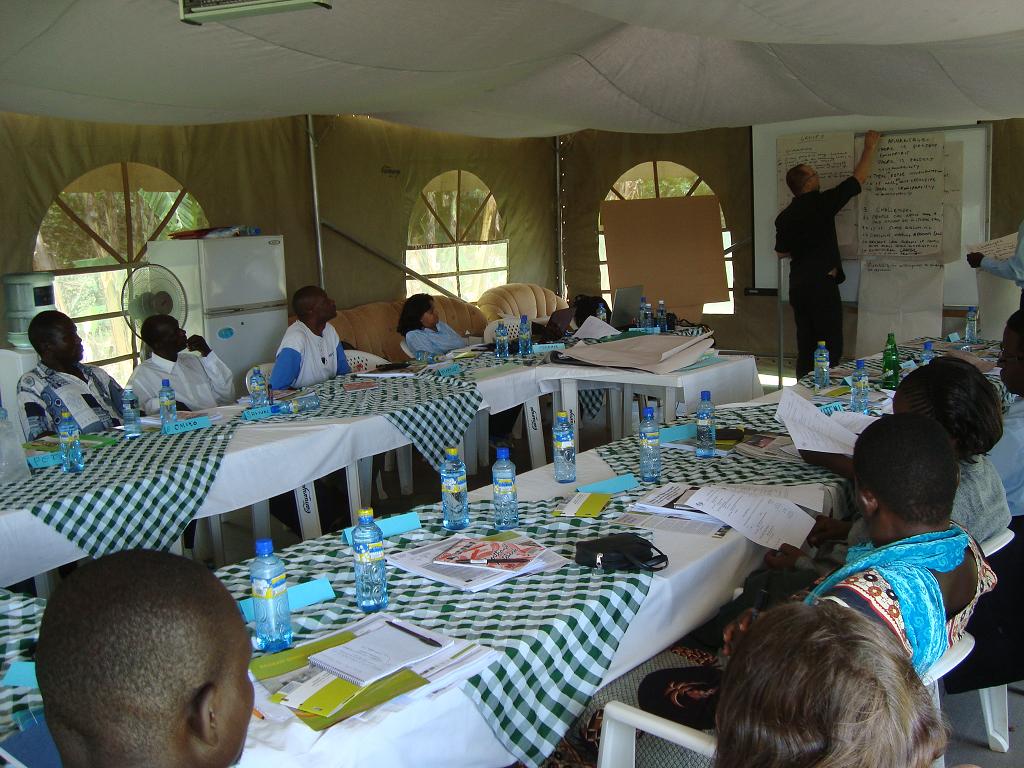
During the following two days I enjoyed the interesting presentations, group works and especially the role plays on topics like Community Participation, CLTS, Social Marketing and Financing.
Participants during workshop in Ugunja
The exchange of information within the group was very enriching and educative as the participants came from different backgrounds and different countries. I realised how important knowledge and information exchange is as for many participants this workshop was like an eye opener and it helped them to understand ecosan and its benefits much better.
Group picture of participants Ecosan Capacity Building Workshop in Ugunja
The Ecosan Vision Workshop on 27th September in Nairobi was out of the ordinary with its “World Café” arrangements where participants were allowed to take notes on the paper covered table as you can see in the picture below.
Participants during the Ecosan VisionWorkshop in Nairobi
It was enjoyable to watch everybody busy writing on the tables and having discussions during group works. The output was very creative and I look forward for the final reports by our facilitator Johannes Heeb and Martin Wafler from Switzerland.
Group picture Ecosan Vision Workshop Nairobi
I am grateful to our presenters during the workshops who were willing to share their knowledge and experience. I further would like to thank all participants, the facilitators from India and Switzerland and last but not least GTZ-Ecosan in Germany for giving us the chance to link up with different people and exchange knowledge and ideas about ecosan in Kenya. It was a great experience to organise the two workshops and it was very motivating and inspiring for me.
Asante sana!
Interesting Blog about fighting for better sanitation in urban slums in Kenya: kenyasanergy.blogspot.com It is great to see so many people try to make live better for the millions of Kenyans living in slums deprived of basic public services such as water and sanitation. Here where flying toilets and open defecation are very common, new solutions and ideas are needed urgently to improve sanitation and the living conditions for a big majority of urban population living in conditions of poverty and low human dignity.
On 5th of August 2009, a launch of the National School Health Policy and Guidelines was held in Nairobi. ECOSAN could support and advice the preparation of the guidelines with experiences made in the ecological sanitation project. The development of the Policy and Guidelines was a collaborative effort between the Ministry of Public Health and Sanitation (MoPHS) and the Ministry of Education. Amongst others, GTZ supported the project in a technical and financial manner, in particular the incorporation of Human Rights and Gender principles, Sexual and Reproductive Health (SRH) aspects, personal hygiene and sanitation into the policy and guidelines. GTZ has been enganged in a comprehensive school health programme in 40 schools in Thika district in Kenya to improve personal hygiene and sanitation. This project focused on improvement of personal hygiene and sanitation in more than 40 schools. The policy and implementation guidelines have been influenced by experiences made in this project and by lessons learned from the water sector and the ECOSAN projects (also supported by GTZ). Thus it appears that ECOSAN contributes to health and hygiene of pupils and teachers.
Poster of the Launch of the National School Health Policy and Guidelines
Household UDDT in Bungoma (source: Moses Wakala, GTZ-Kenya, Jan. 2010)
EU-GTZ/SIDA EcoSan Promotion Project
Type of project: Rural household and school based sanitation
Project period: Start of construction: October 2008 End of operation: May 2010 Ongoing monitoring period until Nov 2010
The EcoSan Promotion Project (EPP) was a project component of the GTZ Water Sector Reform Programme in Kenya and co-funded by the European Union, SIDA and GTZ. It worked in close partnership with the Ministry of Water and Irrigation (Maji House). During the project period (November 2006 - June 2010) 804 doors of double chamber Urine Diverting Dehydrating Toilets (UDDTs) and 13 Decentralized Treatment System (DTS) were installed. Many engineers, artisans and professional companies were trained in the planning and construction of such toilets.
The project’s aim was to develop, test and promote the Ecological Sanitation concept including development of technical designs for large and small-scale sanitation projects in Kenya. The project focused on rural household and school based sanitation but also implemented toilets on public places like bus stations and institutions like prisons. In the rural areas EPP worked directly with CBOs and school authorities. Initially also a few NGOs helped in the implementation such as KWAHO and ALDEF. The EPP also worked together with the water sector institutions such as the Water Services Trust Fund (WSTF), various Water Services Boards (LVSWSB, LVNWSB, ATHI WSB, TANATHI WSB), KEWI and many Water and Sanitation Companies like NAIVAWASS in Naivasha. The WSTF will continue to fund EcoSan facilities around the country in coordination with the regional Water Services Boards and Water and sanitation companies.
Here you can see some nice pictures of UDDTs build by the EPP in Kenya:
UDDTs in rural households:
Household UDDT in semi-desert area of Wajir (source: Patrick Onyango, GTZ-Kenya, June 2008)
Back view of household UDDT in Bungoma (source: Moses Wakala, GTZ-Kenya, Jan. 2010)
UDDTs in schools:
School UDDTs with Urinal at Mwala Primary School, Ukambani (source: Johannes Orodi , GTZ-Kenya, Oct. 2009)
The UDDTs shown above are double chamber urine diverting dehydration toilet. Faeces and urine are separated through a special plastic squatting pan.
See picture below:
Inside of a Urine diversion dehydration toilet (UDDT) with ash container, scoop and instruction posters
The faeces are collected in chambers, where they are dried for at least 6 month while the urine is collected in a 20 liter container connected with a pipe.
Faeces collection chamber (Source: David Watako, GTZ Kenya (July 2009)
Urine collection chamber with collection container
(Source: David Watako, GTZ Kenya (July 2009), Moses Wakala, GTZ Kenya (Jan. 2010))
The urine and the dried faeces of the UDDTs are used as fertilizer on the farms of the UDDT owner. Main crops which the products are used for are maize, bananas, kales and mangos.
For schools or public places with provision of water supply EPP promote a system of low-flush toilet that are connected to a decentralized wastewater treatment system called DEWATS where the human waste is used for production of biogas and irrigation water for agricultural production. The biogas is then used in the kitchen for cooking and helps to supplement firewood. The treated water is rich in nutrients and is used for growing all stable foods like maize, bananas, mangos and vegetables.
Pictures above: DEWATS were biogas is produced implemented in Ambira Boys High School, Ugunja and a public place in Naivasha (source: Laura Kraft and Paul Mboya, GTZ Kenya 2009)
All toilet users were trained and educated on the use of the facility and the reuse and benefits of the human waste. Furthermore health and hygiene promotion was also included as there is a lack of awareness like handwashing after the toilet use. The monitoring and training activities will be ending in November 2010.
Awareness creation and training in Mwala Primary School, Ukambani (source: Paul Mboya, GTZ-Kenya, Oct. 2009)
There are also some awesome videos showing the great work of EEP in Kenya:
Part 1:
Part 2:
Part 3:
Part 4:
For further information please don’t hesitate to contact the persons named below:
Technical Planning and Implementing Support
EU-SIDA-GTZ EcoSan Promotion Project (EPP), Kenya Ministry of Water and Irrigation (MWI) 3rd Floor/Suite 316, Maji House Ngong Road Nairobi Kenya T: +254-20 272 3353
Ecosan network Kenya is a loose network of interested ecosan practitioners, fans and other interested people in productive sanitation. It is based on the work of the EU-SIDA-GTZ EcoSan Promotion Project (EPP) that was running from 11.2007 until 05.2010 under the GTZ water program located at the Ministry of Water and Irrigation, Maji House in Nairobi. After the end of the EPP the GTZ ecosan program in Germany decided to further support ecosan activities in Kenya. Hence this Blog was created to provid a platform for everybody interested in ecological sanitation to exchange ideas to communicate events and to present ecosan projects with the aim to strengthen the ecosan movement in Kenya and East Africa.
We welcome everybody to join as an contributor (author). Please forward your interest to ecosankenya@gmail.com . You will need a gmail or googlemail address to post your stories and announcements.


 Participants during workshop in Ugunja
 Group picture of participants Ecosan Capacity Building Workshop in Ugunja
 Participants during the Ecosan VisionWorkshop in Nairobi
 Group picture Ecosan Vision Workshop Nairobi


