School children at Thirime primary school, Kikuyu, Kenya on Global Handwashing Day. Photo: Thomas Mukoya-Reuters
Close to 20,000 school children and adults took part in a handwashing campaign in an attempt to establish a new Guinness World Record. They gathered at Thirime Primary School in Kikuyu on 15 October 2010 to mark Global Handwashing Day.
Education Permanent Secretary James Ole Kiyiapi announced that 19,352 people, including 18,302 children and 1,050 adults washed their hands during the event. If recognised, this would break the previous record for the most number of people washing hands at a single venue set by 15,150 students in Chennai, India, in 2009. Plan Bangladesh and partners claim to hold the record for the most number of people washing hands at multiple locations, when 52,970 school children gathered across the country in October 2009.
Prof. Kiyiapi announced that every school in Kenya should have a clean toilet for boys and another for girls.
“The Ministry will ensure this happens and they must be properly designed and clean. Out of the money we give to schools, we are going to tell the head teachers to get some of it that was going into instructional materials to construct proper toilets where there are none to improve hygiene,” he said.
Students from over 20 schools in Kikuyu and Dagoretti areas in Kenya took part in Global Handwashing Day events.
We had two very fruitful and successful workshops in Nairobi and Ugunja . During the Ecosan Capacity Development Workshop in Ugunja (Monday 20th September to Friday 24th September) we had the chance to visit different pilot projects in Ugunja, Mumias and Nakuru.
For some of our participants it was the first time to see a working ecosan toilet. And many were surprised how much the farmers appreciate their ecosan toilets. One of the participants told me it was amazing how people use the ecosan products to improve their agricultural production.
Public toilet at the Ugunja market (DEWATS-System)
Double door Urine-Diversion Dehydration Toilet (UDDT) with attached shower in Mumias
During the following two days I enjoyed the interesting presentations, group works and especially the role plays on topics like Community Participation, CLTS, Social Marketing and Financing.
Participants during workshop in Ugunja
The exchange of information within the group was very enriching and educative as the participants came from different backgrounds and different countries. I realised how important knowledge and information exchange is as for many participants this workshop was like an eye opener and it helped them to understand ecosan and its benefits much better.
Group picture of participants Ecosan Capacity Building Workshop in Ugunja
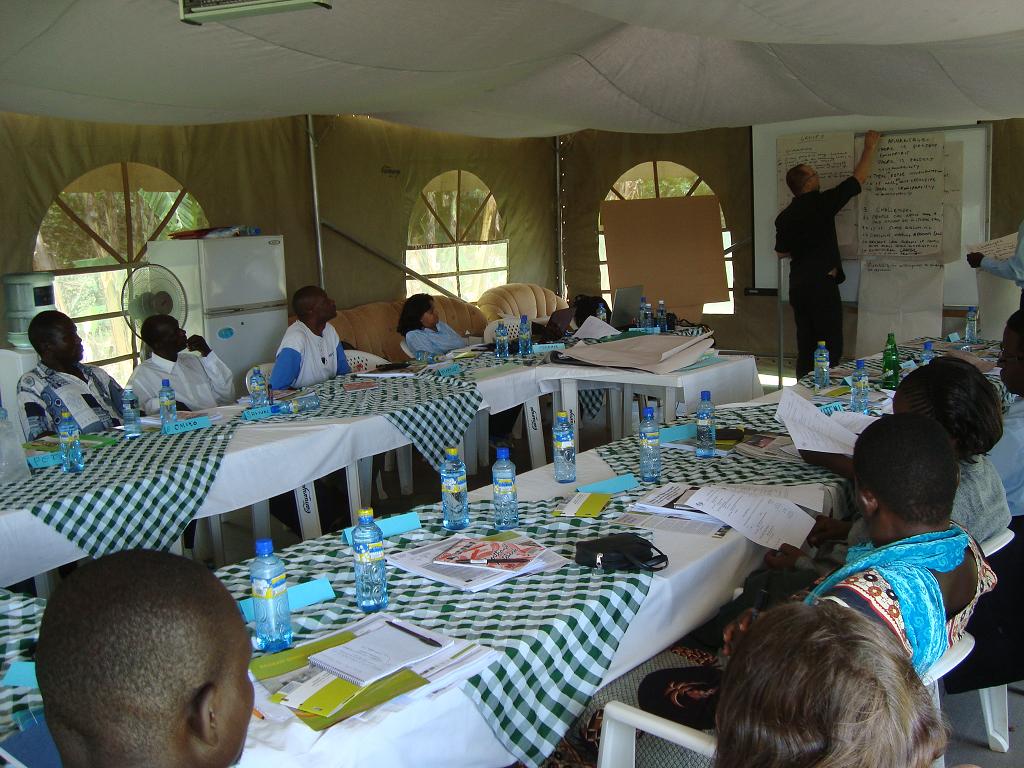
The Ecosan Vision Workshop on 27th September in Nairobi was out of the ordinary with its “World Café” arrangements where participants were allowed to take notes on the paper covered table as you can see in the picture below.
Participants during the Ecosan VisionWorkshop in Nairobi
It was enjoyable to watch everybody busy writing on the tables and having discussions during group works. The output was very creative and I look forward for the final reports by our facilitator Johannes Heeb and Martin Wafler from Switzerland.
Group picture Ecosan Vision Workshop Nairobi
I am grateful to our presenters during the workshops who were willing to share their knowledge and experience. I further would like to thank all participants, the facilitators from India and Switzerland and last but not least GTZ-Ecosan in Germany for giving us the chance to link up with different people and exchange knowledge and ideas about ecosan in Kenya. It was a great experience to organise the two workshops and it was very motivating and inspiring for me.
Asante sana!
Date of Visit - 28TH AUG 2010 Previous Visit - June 2010 Date completed- Feb 2010 Date it was put in use - May 2010 Status - Working well
StatusRamba Boys High school with a population of 938 Boys is a Provincial Boarding school which was selected by EPP as a pilot site for decentralized treatment plant among other sites. The DTS plant was awarded to BINLAW Construction Company who did their best it being their first job of that kind. The EPP team worked hard to ensure that the construction was according to standards and as per the pilot plans. The main works of the contractor included:
Ø Construction of 90 cubic meter biogas Digester.
Ø Construction of a six chamber Anaerobic Baffled Reactor.
Ø Rehabilitation of existing pit latrine to flushable toilet.
Ø Connection of the treated effluent to the farm
The school was previously poorly equipped with sanitation facilities in the compound and the 16 toilets were few and smelly making life so uncomfortable for students. EcoSan Promotion Documentary on Television in Kenya depicted some boys removing shirts and pullovers before visiting these latrines so as not to come out smelling to their class-rooms.
Picture showing the status of the pit Latrines in Ramba School before EPP intervention.
The latrines walls were made of rusty iron-sheets that were coming off. With EPP funding, eight toilets were rehabilitated to permanent flushable units with tiled floor. The school also did rehabilitation of the other eight latrines to equal standard with rain water harvesting. Currently, water tank has been constructed next to the urinal and water from this tank is used to flush the toilets with pour-flush method.
From the visit, one could notice the relief and comfort from the students as they visited the new facility to relieve themselves. The Bio-digester is working well and already a gas is being produced which burned when tested by the consultant. The Baffle Reactor is ok and the farm has been prepared ready for the treated effluent.
KitchenThe burners and kitchen piping has not been done. The consultant has delivered the burners in school and is organizing with the school management on the kitchen piping and fittings.
Toilets
The toilets have been fitted with the gutters for rain water harvesting and the collected water is used in flushing the toilet. The two urinals are also connected to the Digester.
Picture of the eight Rehabilitated pit latrine to flushable toilet in Ramba School.
Digester
This picture below shows the Sealed Neck of the Digester. The top cover is just beside it which needs to be put on top of the neck. Wedging to prevent excess gas pressure from pushing the lid has not been done. This is urgent too. One of the plugs in the test unit manhole adjacent to the Neck is also missing. The school has fenced all the DTS plant to keep off people from unnecessary entry. The consultant is planning for a training of the teachers and students on operation and maintenance. The school need to get one grounds-man to be trained to operate the system.
Masonry tank-This picture below also shows a water holding masonry tank constructed by the school to store water for flushing the toilet. Operation instructions can be seen pinned on the wall. The system is operating well with plastic jerricans used to scope the water (about 2.5 Litres per flush). Treated effluent has not overflowed to the garden. There is a small holding tank about 30 cubic meters dug at the end of the baffle reactor before it flows to the farm.
NAME OF SITE VISITED - ST FRANCIS LWAK GIRLS SCHOOL
Date of Visit - 28TH AUG 2010 Previous Visit - June 2010 Date completed- Feb 2010 Date it was put in use - May 2010 Status: working well
Lwak Girls is a Boarding school with a population of over a thousand girls. The school was chosen as a pilot site of ecosan technology due to an interest in biogas to reduce the firewood cost in school apart from achieving better sanitation. Therefore the school is very much interested in seeing the biogas produced and used in kitchen. The school has many toilets well constructed with flushing systems. Fifty toilets have been connected to the DTS constructed by COMILA Construction Company which was awarded the contract to build a 90 cubic meter Digester and A baffle reactor. The general water consumption in the school is estimated to be about 60 cubic meters per day. Flushing, washing and bathing water that is connected to the digester is about 60% of the total water. During the previous visits, there was a notable smell from the baffle reactor which from inspection was coming from the semi-treated waste from digester being pushed by the excess water inflow. By inspection, some girls were bathing from outside at night and storm water was by mistake channelled to the DTS. All these excess water connections were re-directed to a soak away pit and the foul smell has now ceased. The facility is well in use and waste is full in the digester and Baffle Reactor.
Digester
There was no gas produced from the digester from first inspection. This was as a result of a leakage at the clay seal which had not been attended to from previous visit. In this visit, training was done to the school plumper on sealing and maintaining the DTS components. Kitchen piping components were bought by the school and kitchen piping instruction given to the plumper with two burners to be fitted. The burners were delivered by the consultant to the school. A leakage in the pipe that was detected is to be rectified as piping is in process. The school wishes to have the gas also used in the bakery and requires more information on this.
This Digester neck was found leaking as a result of the clay dried and cracked. Normally, it is kept wet under water to reduce chances of cranking. All the gas had escaped through the neck and there no gas could reach the kitchen. The wedges were removed and the lid pulled aside so as to repair the leakage.
All the dried clay was removed and a better quality prepared clay put well with the plumper so as to understand the procedure of sealing the digester.
Pressing the lid tightly.
Sealing with clay.
Putting water cover on clay.
Summary.
The DTS plant is doing well in operation. The school has dug a big fish pond in the garden waiting for treated effluent. So far no water has begun flowing in the pond because the school had closed.